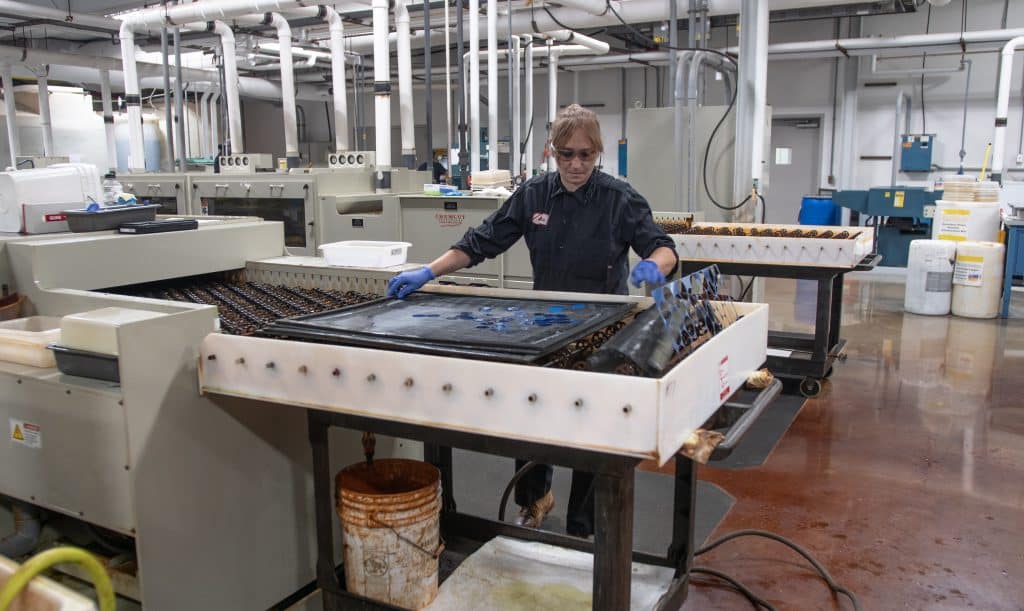
Newcut by Fathom is not a typical machine shop. Instead of cutting tools, drill bits, or molds, the Newark facility uses film, light, and acid to cut thin sheet metal through a process called photochemical machining. The result is a manufacturing method capable of producing components that are too thin, detailed, or delicate for many conventional processes to duplicate.
Photochemical machining uses photography and chemistry to create components from thin sheet metal without time-consuming or expensive hard tooling. Instead, the process relies on films that can be produced directly from CAD drawings in just a few hours and at a fraction of the cost of traditional tooling. That combination makes the process especially well suited for rapid prototyping and design iteration.
The process produces intricate, thin metal parts that would otherwise be significantly more costly, and in some cases impractical, to manufacture. Common applications include:
- Fine mesh screens
- Flat, burr-free electrical contacts
- Sensor components
- EMI shielding
- Micro springs
“A great example is a filter, which contains a very fine network of tiny holes. They are almost impossible to make any other way,” explains Peter Engel, General Manager of Newcut. “Because photochemical machining is a chemical process, it cuts all the holes at the same time in a matter of minutes. If you tried to do the same thing with laser technology, you’d have to cut the holes one at a time, which would take much longer.”
“As with any manufacturing method, time is money. Photochemical machining gets the job done quickly, without the need for expensive molds or tooling. That makes it extremely cost-effective,” he adds.
Newcut by Fathom serves customers across aerospace, defense, healthcare, semiconductor, and other precision-focused industries. These customers share a common requirement: complex flat parts with tight-tolerance features.
How Photochemical Machining Works
Film Production: The first step in photochemical machining is producing a film based on part design. It can be printed in a few hours. Multiple parts can be printed onto a single film. This makes photochemical machining scalable and cost efficient.
Masking: Next, the film is used to expose the design onto a sheet of metal coated with a light-sensitive material called photoresist. The coated metal is then exposed to UV light. Areas where the design allows light to pass through harden, while the unexposed photoresist remains soft and is washed away with a developing solution. The result is a precisely masked sheet of metal ready for etching.
Chemical Etching: The masked metal is sprayed with an acidic etching solution that dissolves the exposed areas of the sheet while leaving the photoresist-protected areas intact. After etching, the remaining photoresist is stripped away, leaving a precisely shaped metal component.
The Biggest Advantage: No Burrs
Many machining, stamping, and metal-forming processes create burrs that must be removed through secondary operations. Photochemical machining avoids that issue by producing burr-free parts, reducing both processing time and cost.
A secondary benefit is that parts processed using photochemical etching don’t have heat-affected edges. Other types of cutting produce heat, which can alter the physical characteristics of the metal. Depending upon the material, cut edges can become hard or brittle. Photochemical machining is a “cold” process that doesn’t produce heat-affected edges.
Post-Processing Options
After etching, additional steps can be performed on parts to enhance their characteristics. Common post-processing steps for photochemical machined parts include:
Precision Forming: Many of the parts Newcut by Fathom makes are fabricated into specific flat shapes, with holes in the proper places. These blanks are then shipped to Incodema by Fathom (about 60 miles away) for forming into 3D shapes.
Plating: Finished blanks may be outsourced to a local supplier for plating. In many cases, however, parts are ready to ship immediately after etching.
Heat Treatment: This may be used at an outside facility to enhance the physical characteristics of the metal.
Flat Parts, Fast
Because photochemical machining does not require expensive tooling or extensive post-processing, it is well suited for rapid prototyping and production applications. Design changes typically require only updated films, allowing the next batch of parts to reflect the revised design quickly.
A Bright Future Ahead
Engel says the future of photochemical machining is bright. In fields such as aerospace, medical devices, and electronics, the continued push toward miniaturization is increasing demand for smaller, more complex sheet metal parts.
“Even though photochemical machining has been around for over 50 years, many engineers still don’t realize it’s an option for some of their part designs,” Engel observes.
With a focus on prototyping, collaborative problem-solving, and small- to medium-volume production, Newcut by Fathom is well positioned to help customers determine where photochemical machining can add value to their designs.