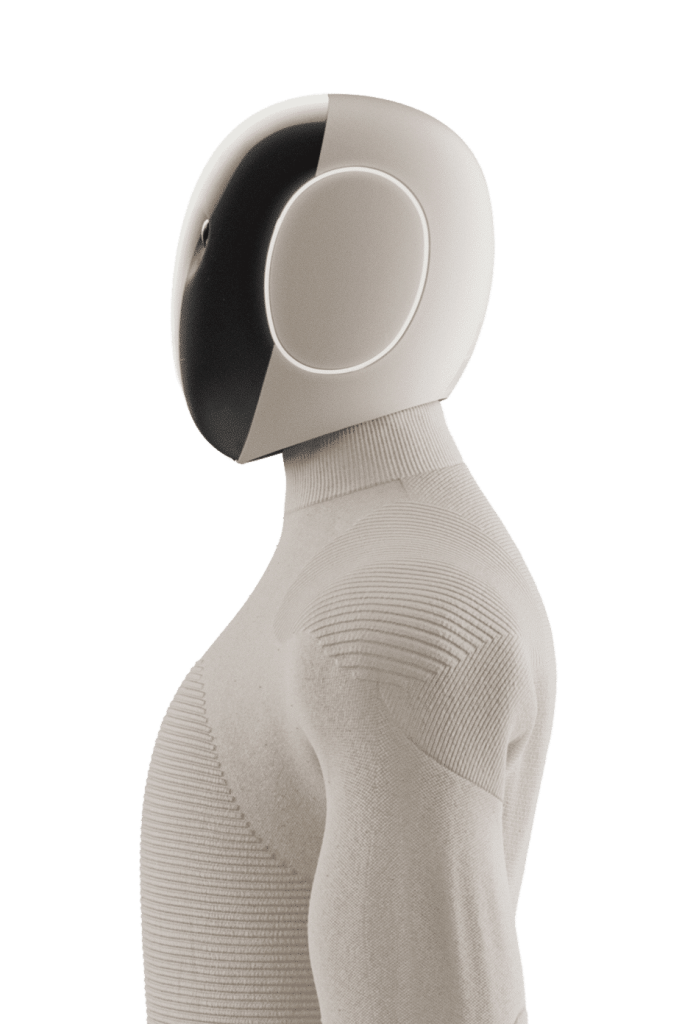
The Supply Chain That Scaled With the Robot
-

CLIENT
Humanoid Robotics OEM
-

INDUSTRY
Robotics & Automation
-

CAPABILITY
CNC Machining, Additive Manufacturing, Photochemical Machining, Surface Finishing & Assembly, Engineering & Design Support, Bridge Production, Inspection Services


Eliminated multi-supplier fragmentation

Accelerated time to design freeze

Scalable supply chain
One Manufacturing Partner for Every Phase of Humanoid Robot Development
A leading humanoid robotics team was racing to bring its next-generation platform to industrial deployment and facing a manufacturing challenge that doesn’t fit neatly into any single supplier’s wheelhouse. The platform had to meet strict cosmetic and surface-finish standards for hardware operating near people, while simultaneously running prototype builds, proof-of-concept hardware, and early bridge production in parallel. Sourcing each phase from a different supplier meant constant re-onboarding, lost revision history, and gaps between what engineering needed and what manufacturing could deliver on the current timeline.
The team turned to Fathom to consolidate that work — spanning precision machined components, validation fixtures, additive prototypes, and Class 1 surface finishing — under one domestic manufacturing partner who could grow with the program from early development through production-ready scale.

The Problem
-
Humanoid robots are held to a standard that most industrial machines never face because they must work around people.
-
That proximity requirement drives strict demands on surface finish, cosmetic quality, and fit-and-function that go well beyond typical mechanical tolerances.
-
Exterior panels, joint covers, and gripper surfaces must meet Class 1 finish standards with precise masking, paint, and turn-key custom finishing. Buyers and end users judge product readiness by what they can see and touch.
-
For a platform still in active development, meeting those standards while also iterating rapidly on mechanical architecture creates a compound manufacturing challenge.
-
Compounding the surface-finish challenge was the pace of development itself. Humanoid robotics teams cannot afford to work sequentially. Prototyping, proof-of-concept builds, and early production efforts all run simultaneously, driven by aggressive commercialization timelines.
-
That means a company must multi-thread its entire manufacturing operation: sourcing prototype-grade parts from one supplier, functional validation hardware from another, and bridge production from a third.
-
Every handoff between suppliers carries the risk of lost institutional knowledge, misaligned revision control, and delays that compress an already tight schedule.

The Solution
Fathom coordinated production across four U.S. facilities to give the engineering team one responsive source spanning every phase of the program — from early prototypes through bridge production.
Minneapolis, MN supplied CNC-machined hinge plates, bearing blocks, actuator interfaces, positional datum parts, torque-test details, and calibration artifacts.
Round Rock, TX handled rapid CNC iterations for robot-joint prototypes, tooling details, and validation hardware as design revisions turned quickly.
Newark, NY produced precision shims, thin washers, encoder and sensor masks, flat spring-like details, and burr-free alignment features where tight tolerances and surface quality were non-negotiable.
Hartland, WI contributed additive motion prototypes, urethane surrogates, CNC bridge parts, DFM guidance around production-intent geometry, and surface finishing work, including masking, paint, and Class 1 cosmetic finishes required for hardware that operates in close proximity to people.
Multiple revision loops ran concurrently with rapid DFM feedback, marked revision levels and dimensional reports — enabling engineering and quality review without waiting for any single supplier to catch up.

The Results
-
By consolidating prototype fabrication, bridge production, and validation hardware under a single domestic manufacturing partner, the team eliminated the fragmentation that typically slows humanoid development programs.
-
Rather than re-sourcing at each stage and losing the institutional knowledge that accumulates across revision cycles, the engineering team moved through design iterations with a consistent manufacturing partner who understood the context behind every change.
-
That continuity accelerated decision-making and kept the program on schedule as motion architectures evolved.
-
Fathom’s multi-site network also gave the OEM a clearer, more scalable path forward. As the platform matured from prototype to bridge production, the supply chain matured with it, with revision-controlled hardware, dimensional documentation, and finish standards already established and ready to scale.
-
The result was a program that could move from early development into targeted production without rebuilding its manufacturing foundation from scratch, giving leadership both the evidence and the production infrastructure needed to commercialize with confidence.