
In late August, Lockheed Martin received a batch of housing components for its PAC-3 MSE interceptor from an unusual source: GM Defense, the military subsidiary of General Motors. The two companies signed their contract on August 6, and the parts arrived on August 28. Lockheed noted that components of this kind have traditionally taken months or even years to produce.
A few weeks later, L3Harris announced a multi-year agreement with the Naval Air Warfare Center Weapons Division at China Lake to manufacture critical missile components for munitions including the Tomahawk cruise missile. The Navy described the arrangement as a way to expand capability and capacity within its organic industrial base for energetics.
Neither deal fits the supplier pyramid the defense industry has relied on for decades. One sends prime-contractor work outward, to a company best known for trucks and SUVs. The other brings a major contractor inside a government-owned facility. Both lead to the same conclusion: the traditional supplier network is running out of room, and the companies responsible for the munitions ramp are looking wherever qualified capacity can be found.
The lines between primes, Tier 1s, Tier 2s and civilian manufacturers are clearly blurring. For sourcing and program leaders, the more useful question is what determines how fast new capacity can start shipping parts that pass inspection.
A supplier network sized for a different demand curve
Much of the defense supply base was built for steady production rates. Many sub-tier suppliers are small, specialized and already qualified across several programs. When demand for interceptors, rockets and ammunition climbs on many programs at once, those shared suppliers become a common constraint. Added shifts and new equipment help at the margin, but a supplier that serves as the qualified source for five programs cannot meet five ramps simultaneously.
That is why the recent deals are worth studying. They show primes and Tier 1s treating capacity as something to go find and develop, rather than something to request from an existing approved supplier list.
Three ways the lines are blurring
“When you’re a large defense contractor and you’re receiving demand signals from the Department of Defense for multiple programs simultaneously, you really only have two choices,” explains Fathom CEO Rush LaSelle.
“They can either aggregate small mom and pop machine shops, which is hard to do because many of them don’t have the required level of quality certifications. Or they can connect with large manufacturers like GM that are built to produce large quantities of vehicles and assemblies at low cost,” he adds.
Commercial manufacturers entering defense programs
GM Defense produced the PAC-3 housings using the casting and machining capabilities of General Motors’ broader industrial footprint. Lockheed and GM have said they intend to extend the collaboration to additional munitions programs and future defense systems. The delivery is part of a wider Department of Defense effort to bring U.S. automakers into weapons production, and the executives of more than one automaker have met with Pentagon officials this year about expanding their role.
Primes partnering with government facilities
The China Lake agreement is not L3Harris’s first arrangement of this kind. In January 2024, its Aerojet Rocketdyne business signed a ten-year agreement with Naval Surface Warfare Center Indian Head to increase solid rocket motor production, with the Navy facility becoming a qualified partner for certain motor manufacturing processes. The model gives primes access to government infrastructure while the government gains industrial production capability.
Large contractors supplying one another
Primes are also building components for programs led by other primes when their process capacity lines up. General Dynamics, for example, agreed to produce solid rocket motors exclusively for Lockheed Martin at its Arkansas facility, starting with motors for the GMLRS rocket. A company that competes for one contract can be a critical supplier on another.
Taken together, these arrangements change the sourcing question. It used to be “who is on our approved list?” Increasingly, it is “who could be on it, and how quickly?”
A fourth “white space” opportunity
Between these options lies another one that Primes and Tier 1s may have overlooked: Contract manufacturers with broad manufacturing offerings and services tailored to serve the extraordinary needs of aerospace and defense.
“Fathom sits between the mom and pop shops and the very large civilian manufacturers,” LaSelle emphasizes. “We offer a breadth of manufacturing solutions, which makes the prime’s job easier. That’s backed by deep engineering expertise, which means we can do design for manufacturability and design for quality. We’re ideally positioned. as a practical option for overflow and second-source work, with the engineering depth to take on part transfers.”
What the 22-day headline doesn’t tell you
The GM delivery is an impressive result, and it deserves the attention it received. It is also a first shipment. It shows that a new source can produce conforming parts. It does not yet show that the source can hold rate. As one industry analyst pointed out, the more telling measures will come later: how many casings ship reliably each month, whether quality stays consistent, and how many parts clear receiving inspection without rework.
The same is true of every new source a prime or Tier 1 brings on. First-article approval is the start of qualification, not the finish. Sustained output depends on process control, inspection discipline and documentation, and those take time to build if they are not already in place.
That points to the less obvious lesson in the GM story. The turnaround was fast because GM Defense was not starting from zero. It brought mature casting and machining operations, quality systems built for high-volume production and deep engineering resources. The speed came from readiness that existed before the contract was signed.
Capacity is a qualification problem
Fathom’s view is that there is more manufacturing capacity in the United States than the defense tier charts suggest. A large share of it sits with contract manufacturers, precision shops and commercial producers that already do adjacent, tight-tolerance work under disciplined quality systems. What is scarce is the ability to move a qualified part to one of those manufacturers and bring it up to rate without a long requalification cycle.
Seen that way, the tier structure was never really a map of who can build a part. It was a map of who had already been qualified to build it. The primes and Tier 1s that meet their ramp commitments will be the ones that shorten the path from “not yet qualified” to “producing at rate” and make that path repeatable.
How quickly a part transfers depends on readiness on both sides of the relationship.
On the supplier side, transfers move faster when the manufacturer has:
- A mature quality management system and experience with first-article inspection and the documentation that goes with it
- Material traceability and record-keeping practices that already match defense customer expectations
- In-house engineering that can review a technical data package and raise manufacturability questions before production begins
- Multiple processes under one roof, so a part that needs machining, finishing and assembly is not split across several new suppliers that each require qualification
- U.S. production and working familiarity with export control requirements
On the buyer side, transfers move faster when the program has:
- A stable, complete technical data package that does not depend on undocumented knowledge held by the incumbent supplier
- A clear view of which requirements trigger full requalification and which can be met with first-article data and existing certifications
- Engineering and quality staff with the bandwidth to support a new source during onboarding
Transfers stall when either side is missing these pieces. A supplier with open floor space but no established quality infrastructure ends up building its systems at the same time as the part. A buyer whose drawings leave out what the incumbent learned over years of production ends up discovering those gaps one nonconformance at a time.
What sourcing teams can do now
- Sort parts by transferability. Mature designs with stable specifications, made with processes that commercial suppliers run at volume such as machining, casting, sheet metal fabrication and molding, are strong candidates for a second source. Energetics and highly specialized processes generally are not.
- Decide what actually requires requalification. Separate the requirements that demand a full qualification cycle from those that can be satisfied with first-article inspection and a supplier’s existing certifications. This is often where months can be recovered.
- Start before the crunch. Qualifying a second source while the incumbent is still delivering means the new source is ready when the ramp arrives, rather than trailing it.
- Track onboarding time as a program metric. Time from purchase order to first conforming article, and from first article to sustained rate, tells a program office more about its real capacity than the size of its supplier list.
- Look across categories of supplier. Contract manufacturers, commercial producers, other primes and government facilities each bring different strengths. The right choice depends on the part, its process and the volume required.
Where Fathom fits
Fathom is a U.S.-based contract manufacturer with more than 30 manufacturing technologies across 7 U.S. locations (certifications vary by location). We work with A&D primes, Tier 1s and defense startups on production parts and second-source programs, with in-house engineering support for part transfers. We are one of many manufacturers whose capacity sits outside the traditional tier structure, and we can be brought into a program with less friction than a supplier starting from scratch.
Fathom VP of Operations Tim Bowman provides an illustration of how this works in practice:
“We can take a project that needs to be done across many manufacturing technologies and we manage that through every step in-house. For example, we’ve got an optical company that has given us one of the toughest parts I’ve seen in my 30 years of manufacturing. It requires DMLS (metal additive manufacturing), heat treating, wire EDM, CNC machining and a special coating. It requires frequent inspections and sophisticated flowdowns. We have managed this project all the way from NPI to production.”
The blurring will continue
The pressure behind these deals is not going away. As long as munitions demand outpaces the traditional supplier base, primes and Tier 1s will keep reaching into commercial industry, government facilities and one another for capacity. The organizations that do this well will treat supplier onboarding as a production capability in its own right, measured and improved like any other part of the program.
How to evaluate second sourcing options
As we’ve seen, second sourcing a qualified part takes more than an RFQ. To help you explore your options, we’ve developed a 40-point second sourcing evaluation tool, which can help you assess if a part is ready to move based on six dimensions:
- Part definition and data package
- Requirements and flowdowns
- Special processes and qualification
- Inspection and first article
- Capacity and schedule
- Supply chain and materials
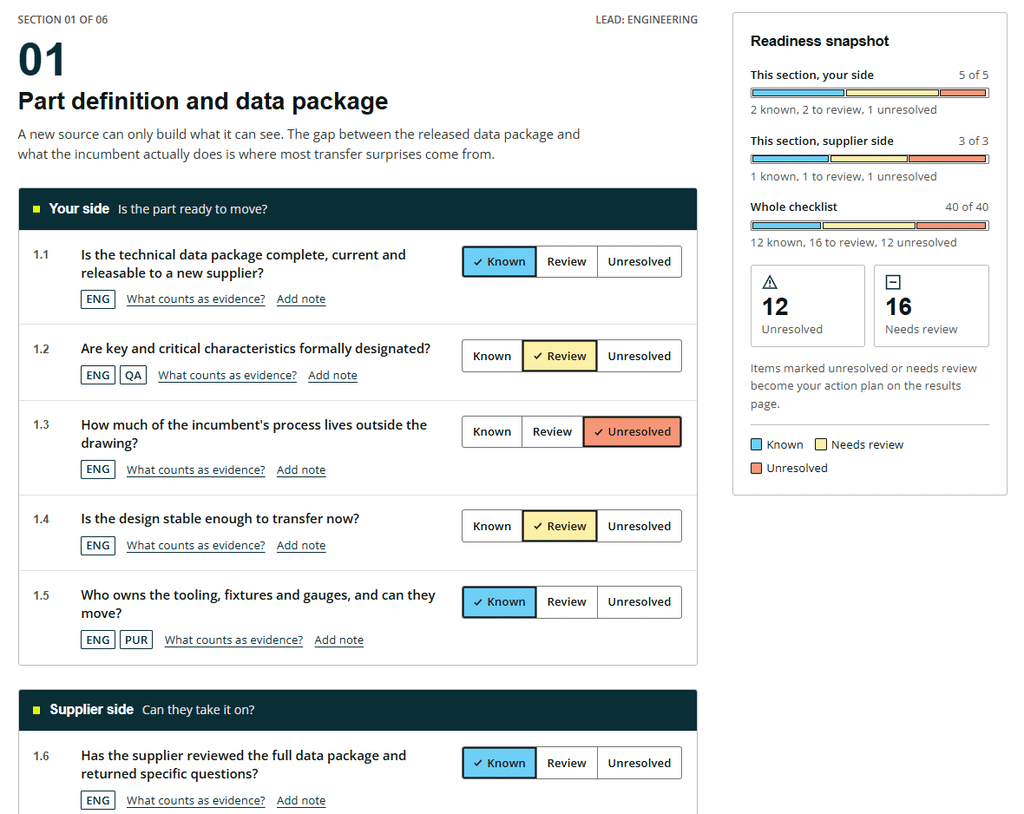
Assess the readiness of your parts for second sourcing.
If you are evaluating a second source for a qualified part, contact us to discuss your needs.