When a weapon is designed to be lost, the supplier quality model built for weapons that must never fail becomes the most expensive thing in the bill of materials.
The Department of War has now put hard numbers on what “low cost” means. Phase 3 of its Drone Dominance Program, opened September 28, sets aside $450 million for roughly 60,000 attack drones, priced at $5,000 each for Deep Strike (before weaponization) and $3,000 for Close Quarter Battle (DroneXL). Before any company flies in Gauntlet III, it must first deliver a 400-drone production order in about two months. The department’s FY2027 request goes further, with $53.6 billion aimed at autonomy, drone platforms and contested logistics (DefenseScoop).
Most of the conversation about attritable systems centers on airframe design, autonomy and doctrine. Far less attention goes to a quieter problem sitting one layer down in the supply chain: the way defense programs qualify and inspect parts was never built for a product whose unit price is lower than the cost of documenting its first article.
A quality system designed for things that must never fail
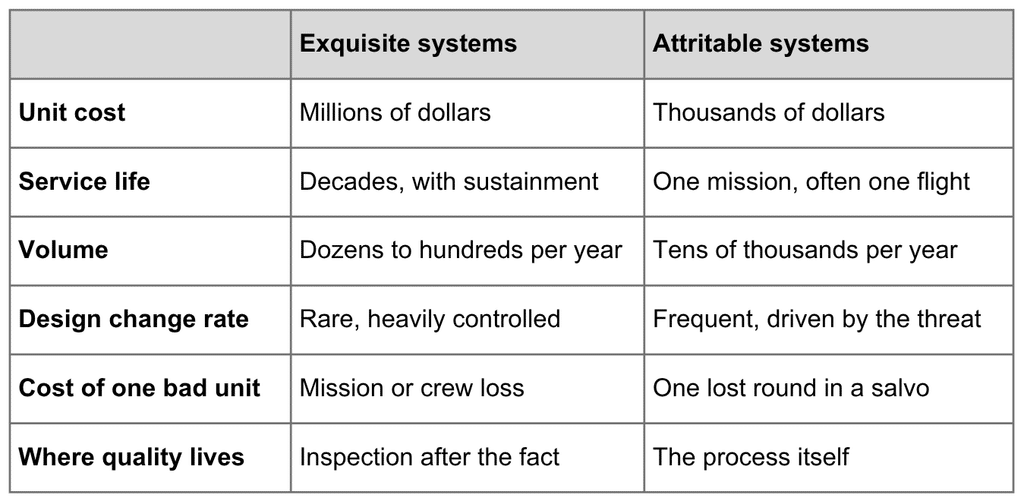
Defense qualification grew up around exquisite platforms: fighters, satellites, precision munitions and radars that cost millions per unit and stay in service for decades. When one of those fails, the consequence is a lost crew, a lost mission or a fleet-wide grounding. Under that logic, it makes sense to spend heavily to prove every part is right.
So the system front-loads verification. A new part typically goes through a full first article inspection under AS9102, with every characteristic on the drawing ballooned, measured and recorded. Source inspection, customer witness points, material certifications traced to the melt, and a material review board for any deviation all follow. Changing a supplier, a process or even a machine can trigger requalification, which is why a qualified source often stays qualified for a generation.
None of this is wasted effort on a $2 million interceptor. The inspection cost is a rounding error against the unit price, and the long service life spreads the qualification cost across years of use. The model is rational for the product it was built around.
The attritable paradox
Attritable systems invert every assumption that justified the old model. The product is meant to be expended, often on its first flight, and the program wins by fielding mass rather than by guaranteeing each unit. At a $3,000 to $5,000 price point, the fixed cost of proving a part is right starts to rival the cost of making it.
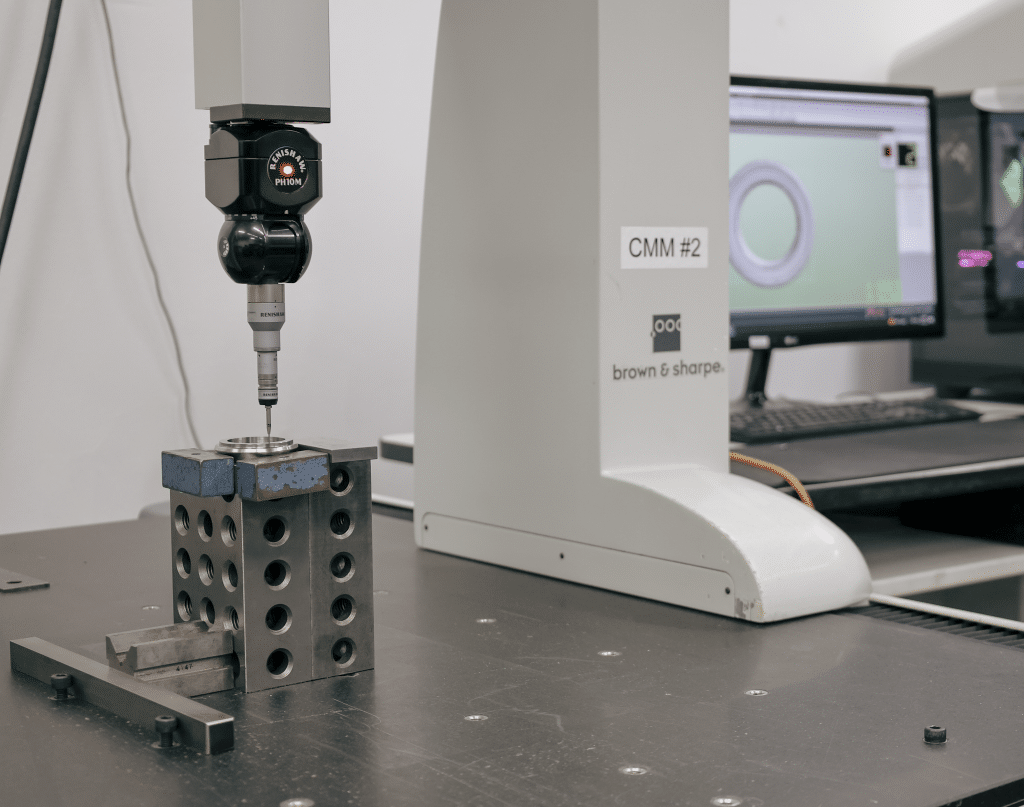
Consider a simple illustration. Say a first article package for one machined or molded part takes 12 hours of quality engineering and CMM time at a loaded rate of $120 an hour. That is about $1,440 per part number before production begins. A small drone with 40 custom part numbers carries more than $57,000 in first article cost alone, and every design revision, material substitution or second source restarts the clock. Add 100% dimensional inspection on the production floor and the inspection line can outgrow the machining line.
The schedule cost is worse than the dollar cost. Attritable programs iterate hardware in weeks because the threat changes in weeks. A qualification cycle measured in months means the part that finally clears inspection may already be obsolete.
The tempting response is to simply inspect less. That is the wrong lesson, and the program’s own delivery record shows why. The government pays its fixed price only for drones that are delivered and accepted. As of the program tracker’s September 10 update, it had accepted 57% of the Gauntlet I base orders, and the top-scoring vendor had shipped half its order with none yet accepted (drone-warfare.com). Reporting attributes most of the lag to shortages of NDAA-compliant components rather than rejected parts (Inside Unmanned Systems), but the point holds either way: a drone that scores well on the range and stalls before acceptance earns nothing. Attritable does not mean unreliable; it means the reliability has to come from somewhere cheaper.
Commercial industries solved this decades ago
Automotive, consumer electronics and medical disposables all ship enormous volumes of low-margin parts where a field failure is still costly. None of them can afford to inspect their way to quality, so they build it into the process and verify the process instead of every part.
The toolkit is well established:
- Process capability as the acceptance criterion. A process running at a Cpk of 1.33 or better on critical characteristics produces parts that are right by design. Once capability is demonstrated, sampling replaces 100% inspection.
- Statistical process control on the floor. Operators chart key dimensions in real time and act on trends before a part goes out of tolerance, so drift is caught at the machine rather than at receiving.
- Process FMEAs and control plans. Risk is analyzed once, up front, and the control plan names exactly which characteristics get monitored, how often and by what method.
- Error-proofing. Fixtures, go/no-go gauges and in-machine probing make the wrong part physically hard to produce.
- Production part approval. Automotive’s PPAP approves the process that makes the part, including its tooling, material and settings. Change the process and you requalify; run the process as approved and every part inherits that approval.
The shift is from asking whether this part is good to asking whether this process can only make good parts. The first question has to be answered 60,000 times. The second is answered once and then monitored.
What changes for buyers and suppliers
The programs that hit attritable cost targets will be the ones whose supply chains adopt this model deliberately rather than by accident. That changes the job on both sides of the purchase order.
For primes, Tier 1s and program offices, the question in supplier selection moves from “can you pass our inspection” to “can you show us your process data.” That means asking for capability studies on critical characteristics, reviewing control plans instead of stacks of inspection reports, and writing flowdowns that approve a process rather than a single lot. It also means drawing a clear line between the few flight-critical and safety-critical features that still warrant full verification and the many features that do not.
For defense startups, the risk runs the other way. Many are building attritable systems with commercial speed but have not yet decided what their quality system is. Borrowing the full exquisite-system playbook will price them out of their own cost targets. Skipping discipline entirely will show up as field failures during the first production surge. The middle path is a lean, process-based system designed in from the first build.
For manufacturers, capability becomes the product. Shops that can demonstrate stable, measured processes across machining, molding, sheet metal and additive, and hand over that data cleanly, will be easier to qualify and cheaper to keep. Shops that rely on final inspection to catch problems will find that cost impossible to hide at $3,000 a unit.
The transition will not be clean. AS9100 and AS9102 are not going away, and exquisite programs will keep running on them. Many suppliers will need to operate both models side by side, sometimes in the same building, and know which one each program calls for.
The quiet bottleneck in the drone buildout
The attritable era will be decided on factory floors as much as on test ranges. Budgets and doctrine have already moved. The supplier quality model has not, and it is on track to become the constraint that keeps cheap weapons from staying cheap.
Fathom works with defense primes, Tier 1s and startups across 30+ manufacturing technologies at 7 U.S. locations, from early prototypes through production. If your team is sorting out how to qualify suppliers for an attritable program without inheriting the cost structure of an exquisite one, talk to our A&D team.