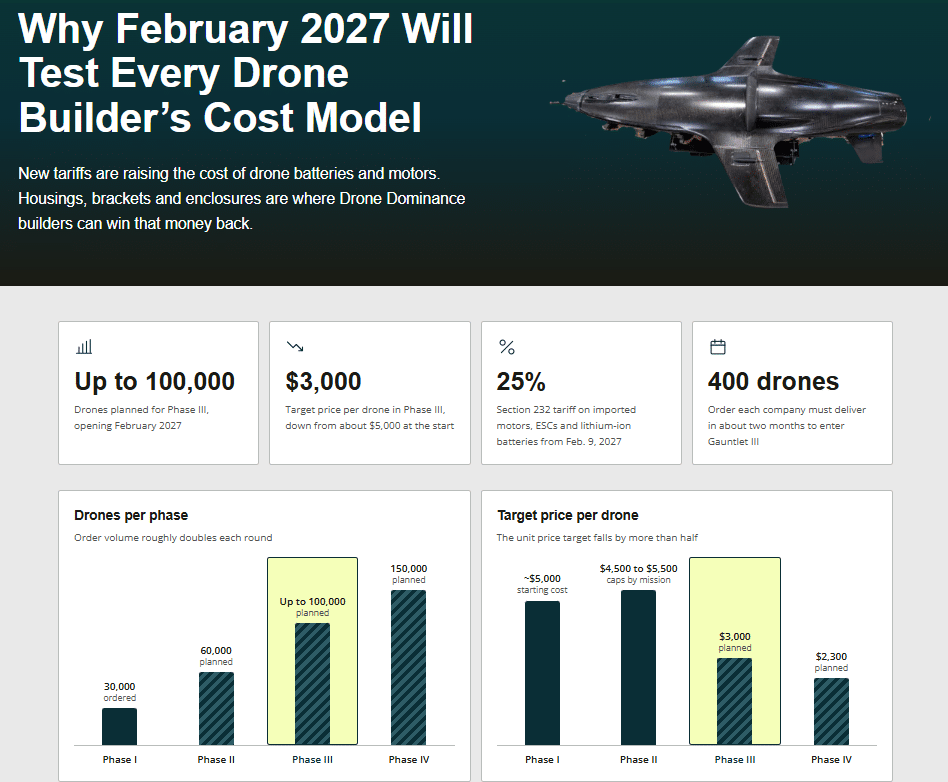
Drone Dominance has one rule that gets harder every round: Build more drones, for less money, with fewer foreign parts. For Gauntlet II, the program set a unit price ceiling of $4,500 for short-range systems and $5,500 for long-range systems, along with stricter limits on Chinese components than Gauntlet I. Across the full program, the goal is to push unit costs from about $5,000 down toward $3,000.
Now layer on the Section 232 drone tariffs announced in August. They put new duties on imported drones and on the components drone builders depend on most, including the lithium-ion batteries, motors and electronic speed controllers that drive a big share of a small UAS bill of materials.
Most teams can’t do much about those electronics in the near term. What they can control is everything they design themselves: the housings, brackets, mounts, trays and enclosures that hold the system together. Those parts are where a cost target can be recovered, and they’re the easiest place to show domestic content.
What the new Section 232 drone tariffs actually change
The August 13 proclamation imposes tariffs in two waves:
September 3, 2026. A 100% tariff now applies to drones with a maximum takeoff weight above 25 kg, drones with thermal imaging, drone docking stations and a set of critical components listed in the proclamation’s Annex I. Smaller drones without thermal imaging face a 25% tariff.
February 9, 2027. A 25% tariff takes effect on additional components listed in Annex III. The administration has named motors, electronic speed controllers and lithium-ion batteries among the areas where U.S. drone production depends most on foreign sources.
There is some relief, but it comes with conditions. Qualifying drones and components from the EU, Japan, South Korea, Taiwan, Switzerland and Liechtenstein may be capped at 15%, and UK products at 10%. To qualify, substantially all of the hardware, software and technology must originate in those countries and the U.S. Companies that commit to building or expanding U.S. drone production facilities may also get temporary relief while that construction is underway. That helps teams standing up new factories, not most builders trying to hit a delivery date.
What this means for your BOM: Some components are already exposed. Others will be in February 2027, which is right in the middle of many Gauntlet II delivery windows. Coverage depends on the specific annex listings, so confirm HTS classifications with your trade compliance team before you finalize cost models.
Why the electronics problem won’t be solved this program cycle
Domestic and allied capacity for battery cells, brushless motors and ESCs is thin, and the builders who already have qualified sources are competing for the same limited supply.
Switching sources isn’t a simple swap. A new cell chemistry or motor can change flight time, thrust, thermal behavior and payload margins, which means retesting a design that has already proven itself. Making that change in the middle of a production order adds technical risk at exactly the wrong moment.
Teams should start migrating these parts now. But it’s risky to count on electronics to recover margin before the current delivery window closes. The parts with the shortest path to lower cost and domestic sourcing are the ones your own engineers draw.
Production readiness is now the test
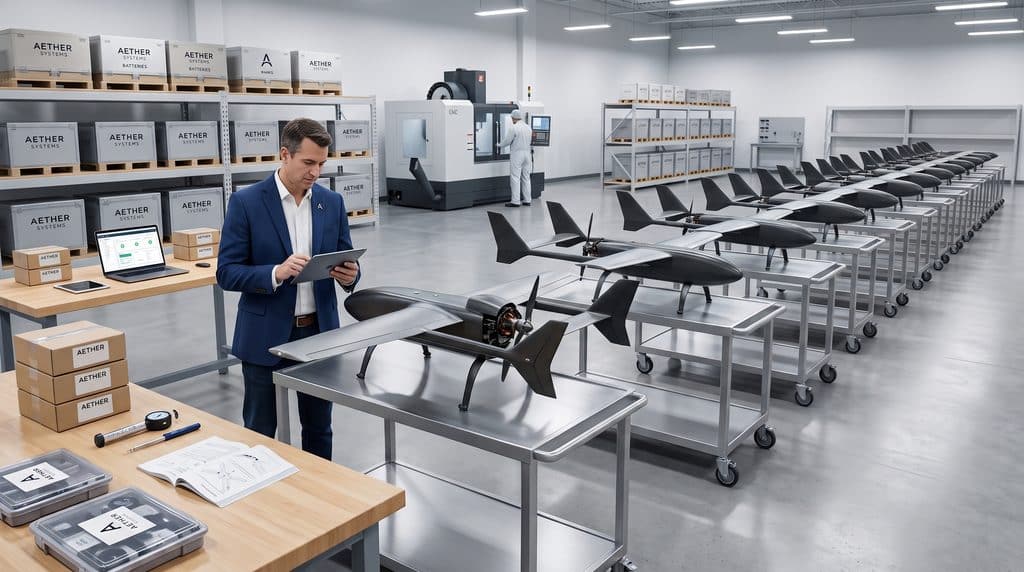
Gauntlet II made it clear that Drone Dominance is a manufacturing competition as much as a flight competition. Of 49 companies that entered the qualifier, 19 advanced, and each had to deliver 120 live drones in about five weeks just to reach the final event. On September 15, the program named ten finalists. Each must deliver 4,000 to 8,000 drones within five months of its order, using parts that meet a supply chain standard stricter than the NDAA.
That volume exposes design decisions that were perfectly reasonable at prototype quantities:
- A printed housing that takes hours per unit on a single machine type
- A machined bracket with tolerances only one shop can hold
- An enclosure that calls for a specialty material with a long lead time
- An assembly with a dozen fasteners and inserts that each need their own supplier
None of these will stop a prototype. All of them can stop a production ramp. If you want a structured way to find them, our DFM Red Flag Diagnostic Guide walks through the most common warning signs.
Six ways to take cost out of drone mechanical parts
Design for manufacturability (DFM) and design for cost are the fastest levers drone teams have right now. Here’s where to start.
1. Simplify geometry
Undercuts, deep narrow pockets, thin unsupported walls and tight internal radii all add machining time, tooling complexity or scrap. Often they exist because the part was first designed for a 3D printer, where complexity is close to free. At volume, it isn’t.
Watch for: Features that carry load or locate other components. Simplify the rest first.
2. Relax tolerances you inherited
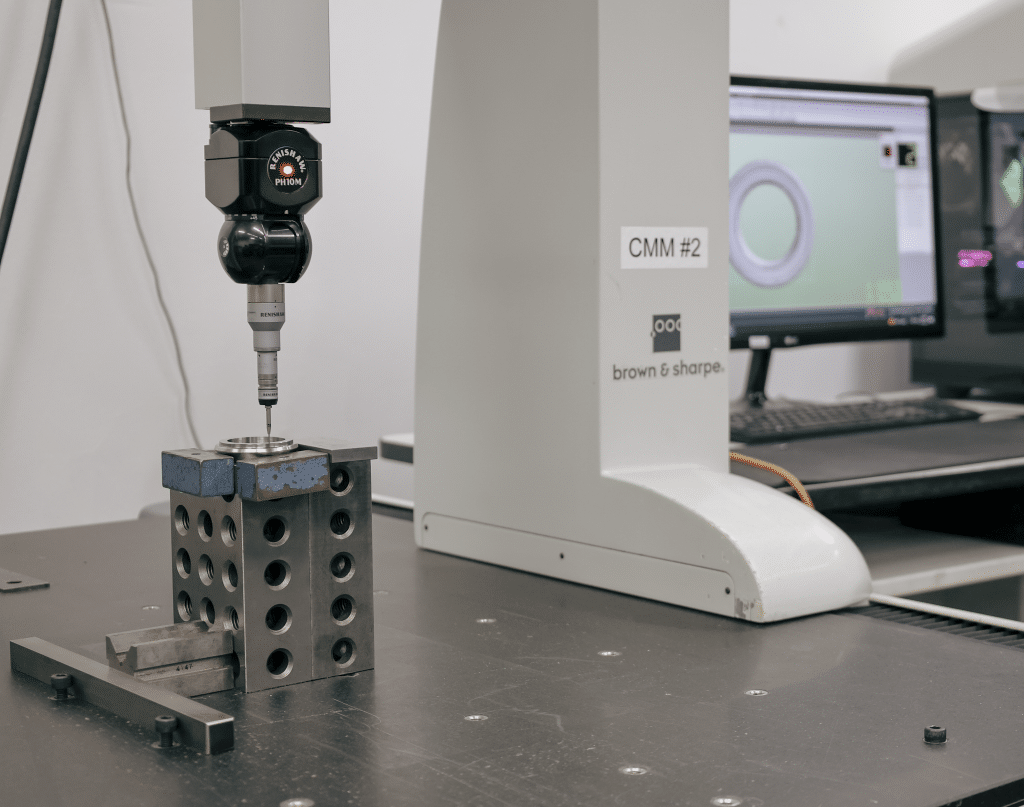
Many prototype drawings carry a default tolerance block applied to every feature, whether it mates with anything or not. Tight tolerances on non-functional surfaces drive cost through slower machining, extra inspection and higher rejection rates.
Watch for: Sealing surfaces, bearing fits and motor mounting interfaces. Tie every tight callout to a specific fit, seal or load requirement, and open up the rest.
3. Consolidate parts
Combining a bracket, spacer and mount into a single part removes fasteners, assembly steps and purchase orders. Every part you eliminate is also one less supplier to qualify and one less line item to document for country of origin.
Watch for: Serviceability. A one-way attack drone rarely needs field repair, but a reusable platform might.
4. Substitute materials or processes
The process that made sense for 20 units may be the wrong one for 8,000. Common shifts include moving machined aluminum brackets to formed sheet metal, moving printed housings to injection molding or die casting at volume, and replacing a specialty polymer with a readily available glass-filled nylon that meets the same requirements.
Watch for: Weight. Run the substitution through your mass budget before committing, because every gram matters on a small UAS.
5. Design for the production process early
The cheapest time to change a process is before tooling is cut and before a design is locked for a production order. If you know a part will move from printing to molding, design it now with draft angles, uniform wall thickness and gate locations in mind, even if the next batch is still printed. Our Drone Lifecycle Manufacturing Processes infographic shows how these transitions typically unfold and outlines the decisions you need to make as production ramps.
6. Design for the mission’s actual life
An attritable drone doesn’t need a housing built to last for years. Cosmetic finishes on internal surfaces, coatings sized for long-term corrosion resistance and safety factors carried over from reusable aircraft can all be revisited against the real mission profile.
Watch for: Storage and transport conditions. A drone may sit in a depot for months before it flies once.
Where cost hides in a typical drone housing
Consider a hypothetical avionics housing carried over from a prototype build. A design-for-cost review would typically look at things like:
- Tight tolerances on exterior surfaces that touch nothing
- A a cosmetic finish called out on interior walls no one will see
- Threaded inserts that could be replaced by molded-in features
- A part machined from billet when a formed or cast part would meet the load case
- Wall thicknesses set by a printer’s minimums instead of the structural requirement.
None of these choices was wrong for a prototype. Each one costs money at production volume.
Domestic mechanical parts are your easiest compliance win
Under a supply chain standard stricter than the NDAA, every component needs a clean origin story. Housings, brackets and enclosures are the most straightforward place to raise documented U.S. content, because the raw materials and manufacturing processes are widely available domestically.
That matters for procurement teams as much as engineers. Fewer suppliers mean fewer certificates of conformance to chase, simpler traceability and less exposure if one vendor’s sourcing comes into question. The program also publishes a supply chain migration schedule at DroneDominance.mil, so map your bill of materials against it now rather than at the next qualification gate.
A practical sequence for program teams
- Tag your BOM by tariff exposure and timing. Separate components exposed now, components exposed in February 2027 and components that aren’t covered.
- Rank mechanical parts by cost, lead time and sourcing difficulty. A short list of five to ten parts usually accounts for most of the opportunity.
- Run a DFM and design-for-cost review on the top items. Bring engineering and procurement into the same review so trade-offs get made once.
- Lock the production process and qualify domestic sources. Do this before your order quantities are set, not after.
- Work the electronics migration in parallel. Start qualifying alternative batteries, motors and ESCs now, so you’re ready for the next Gauntlet even if this one runs on your current sources.
How Fathom can help
Fathom’s applications engineers help drone teams refine geometries, tolerances, materials and processes so parts are easier to build, repeat and scale. With 30+ manufacturing technologies across 7 U.S. locations, we can move a part from printing to machining, sheet metal, molding or casting without changing suppliers, and support you from prototype through bridge and production builds.
If your cost target is slipping or your mechanical parts are starting to look like a bottleneck, let’s talk.
Request a design-for-cost review of your top five mechanical parts.
Learn how we can help you scale your Drone Dominance design (we’ve worked with many drone manufacturers!).
Visualize the chokepoint
Take a closer look at how the NDAA tariff restrictions, ramp and cost-reduction targets are related, and why February 2027 is a critical timeframe for drone builders.