Group 3 VTOL ISR Drone
-

Client
A U.S. manufacturer of Group 3 VTOL ISR aircraft fielded by multiple military and maritime operators
-

Industry
Aerospace & Defense
-

Capabilities
Design for Manufacturability (DFM), CNC Machining, Precision Sheet Metal Fabrication, Additive Prototyping, Finishing, First Article and Dimensional Inspection, Revision-Controlled Kitting
Engineered five operator-specific payload configurations around one common payload interface

Released 18 payload ECOs in 10 months without missing a flight-test window

Cut field payload swaps from roughly 45 minutes to under 10
Payload Changes That Reach the Flight Line Without Another Redesign Cycle
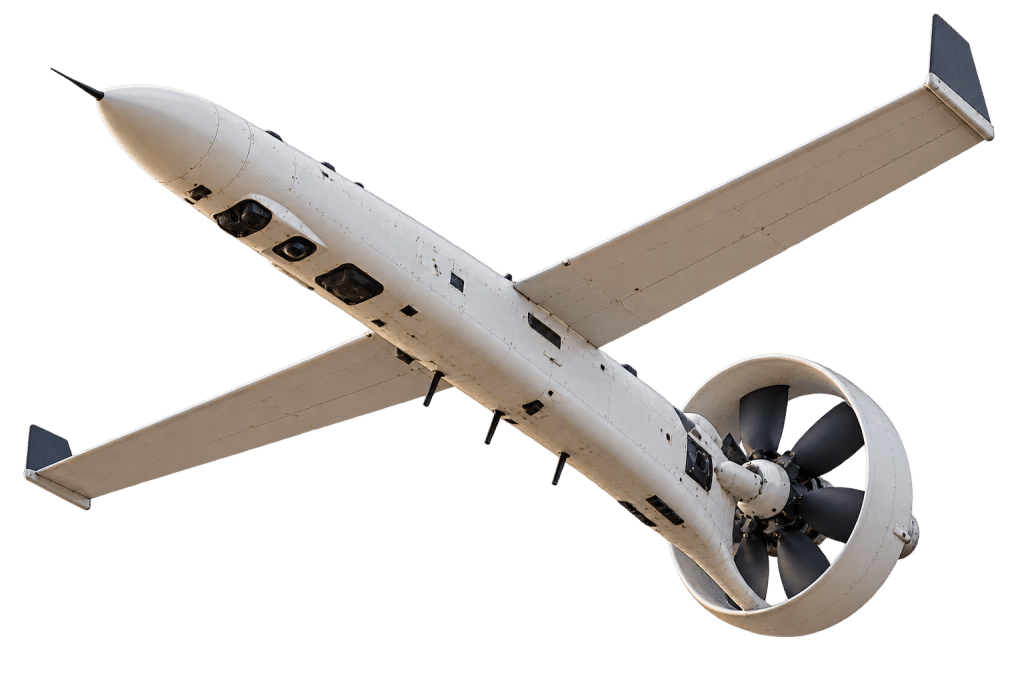
A U.S. manufacturer of Group 3 VTOL ISR aircraft had won business with several military and maritime operators, and each one wanted something different in the payload bay: EO/IR sensors for overland surveillance, maritime-search sensors, communications relays and targeting packages.
Every variant had to fit the same compact bay, stay inside a tight weight budget, shed heat from high-power electronics and come out quickly in the field. The company’s integration engineers were redrawing brackets, cable guides and access covers for each new request. Every change sent them back through quoting and lead times with their machine shops.
Fathom’s engineering team applied DFM across the aircraft’s payload support hardware, building every configuration around a common machined interface and designing for fastener access, cable routing, coating stack-up and quick swaps. Additive fit-check parts caught interferences before flight test, and payload ECOs moved through as controlled revisions with inspection-backed releases.
Over ten months, 18 changes across five configurations reached the aircraft without costing the program a single flight-test window.

The Problem
-
Package variations: Each operator specified its own EO/IR, maritime-search, communications or targeting payload, and every variant had to fit the same compact payload bay
-
Managing SWaP trade-offs: Any weight added to payload support hardware came directly out of endurance and time on station
-
Thermal management was a must: High-power sensors and radios needed dependable thermal paths inside an enclosed fuselage
-
Simplifying payload swaps was a priority: • Field crews had to reach connectors and swap payloads at austere sites and aboard ship using basic hand tools
-
Managing configurations was dominating engineers’ time: • Integration engineers were redesigning small mechanical details for every configuration instead of focusing on mission-system integration
-
Each ECO restarted the clock: Each ECO restarted quoting and lead times, and interference problems often went undetected until flight test

The Solution
-
DFM of mechanical components up front: DFM review of payload mounts, gimbal supports, thermal plates, connector panels, cable guides, antenna brackets and access covers before any production-intent part was cut
-
Mounting system simplified: A common machined payload interface plate with locating pins and a standard bolt pattern, so each new configuration needed only a lightweight adapter rather than a new mounting scheme
-
Redesigned metal components balanced weight and strength: Pocketed CNC gimbal supports and consolidated bracket assemblies that removed weight while holding the stiffness needed for stable imaging
-
Thermal plates protected key electrical components: Thermal plates toleranced to post-finish dimensions, with masked contact and grounding surfaces so coating stack-up never compromised heat transfer or electrical bonding
-
Cable guides simplified wiring: Formed sheet-metal cable guides with defined bend radii and tie-down points to keep harness routing repeatable from one configuration to the next
-
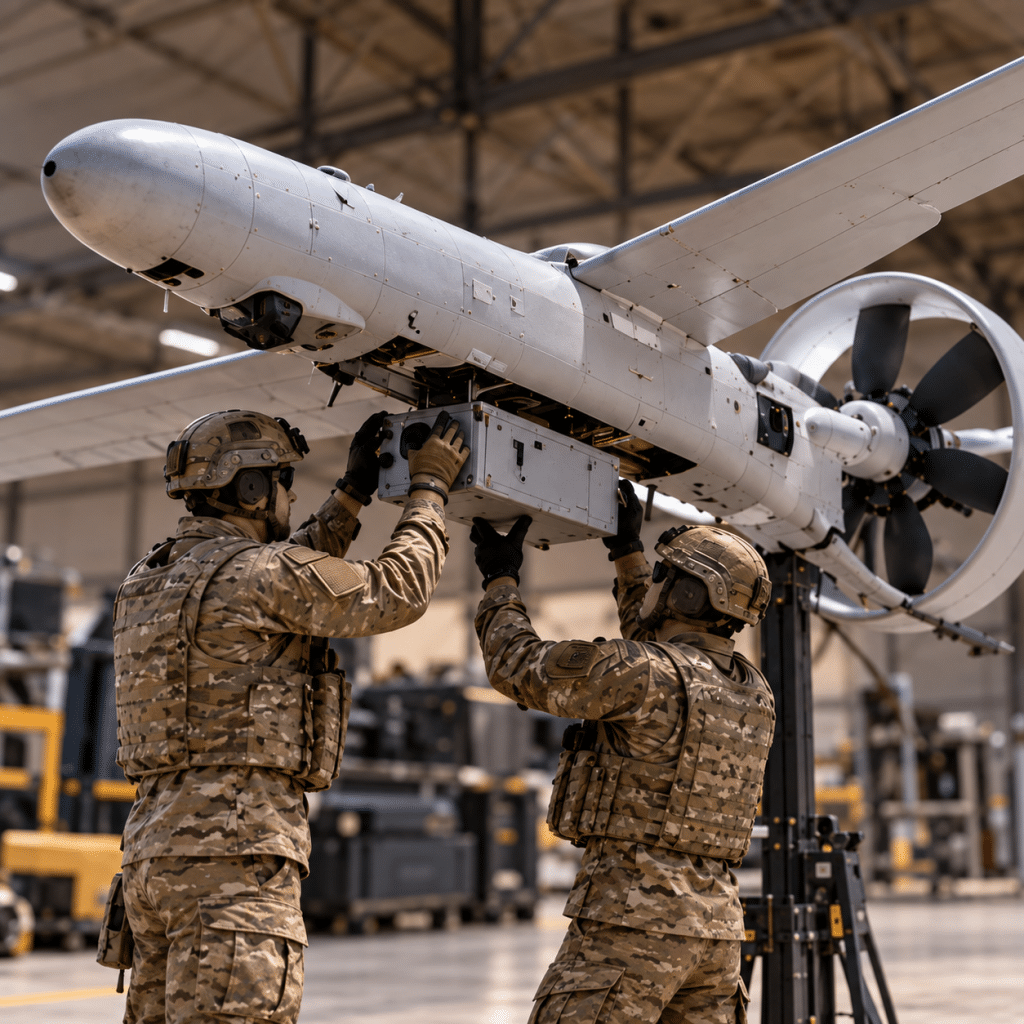
Additive parts used to verify designs prior to flight test: Additive fit-check parts and validation fixtures that confirmed clearances and cable paths before hardware reached flight test
-
Efficient paperwork flow speeded development: ECOs managed as controlled revisions against a documented baseline, with first article inspection, dimensional reports and configuration-specific labeling and kitting for each mission set

The Results
-
Common payload interface: Five operator payload configurations now share one common interface on the airframe
-
ECOs without schedule slip: Eighteen payload ECOs were released in 10 months without missing a scheduled flight-test window
-
Faster turnarounds in the field: Field payload swaps dropped from roughly 45 minutes to under 10
-
Lighter payload hardware: Payload support hardware weight fell by 19%, returning margin to endurance and sensor capacity
-
Problems caught before flight test: Additive fit checks caught nine interference conditions before any hardware reached the aircraft
-
Configuration-ready kits: Each mission kit now arrives labeled and kitted by configuration
-
Engineers back on the mission: Internal engineers have shifted their time back to mission integration